

Agreed Value vs Stated Value Car Insurance in Florida
Key Takeaways
- Agreed value means the insurer commits, in writing and before any loss, to pay a fixed dollar amount if your car is totaled — no depreciation argument, no appraiser haggling
- Stated value is the trap most drivers fall into: the wording in most policies pays the lesser of the stated amount or the actual cash value, so you can pay for a $60,000 figure and collect $34,000
- Actual cash value (ACV) is the default on virtually every standard Florida auto policy — market value the moment before the crash, depreciation included
- In Florida a vehicle is a total loss once repair cost reaches 80 % of replacement cost (Fla. Stat. § 319.30(3)) — collector cars cross that line fast because parts and labor are specialized
- Agreed value is normally sold on a collector or classic policy, which comes with real conditions: a separate daily driver in the household, garage storage, limited annual mileage and a clean record
- Agreed value is not gap insurance. A financed new car with negative equity needs gap coverage, not an agreed-value endorsement
If you own a car that is worth more than a valuation book says it is — a restored Mustang, a low-mileage 911, a modified truck, a 1990s Land Cruiser that keeps appreciating — then the single most important line in your policy is not the deductible. It is the sentence that decides how the payout is calculated on a total loss. That sentence is where agreed value, stated value and actual cash value part ways, and the difference is routinely tens of thousands of dollars.
Three ways an insurer can value your car
Every physical-damage claim ends with one question: what was this vehicle worth? There are only three answers in common use in Florida, and they are not interchangeable.
| Valuation method | What the insurer pays on a total loss | Who it is really for |
|---|---|---|
| Actual cash value (ACV) — the default | Market value immediately before the loss, minus your deductible. Depreciation, mileage and condition all pull the number down, and it is set after the accident by the carrier’s valuation vendor | Ordinary daily drivers that lose value every year |
| Stated value (also called “stated amount”) | Usually the lesser of the stated amount or the actual cash value. The stated figure caps the payout — it does not guarantee it | Mostly used to limit a carrier’s exposure on commercial fleets and older units. Rarely the right answer for an enthusiast |
| Agreed value (sometimes “guaranteed value”) | The exact amount written on the policy, with no depreciation deduction — and on many collector policies, no deductible on a total loss | Classic, antique, collector, exotic, restored and heavily modified vehicles |
Read the stated-value row twice. The name suggests a promise, and the policy language usually delivers a ceiling. That is the most expensive misunderstanding in specialty auto insurance, and it only surfaces at claim time, when nothing can be changed.
Marine insurance uses “agreed value” for regular boats, not just collectible ones — an agreed-value hull policy is standard on many Florida vessels, while an ACV hull policy depreciates your boat every season. If you own both a collector car and a boat, ask about each separately; see our boat insurance page.
What the difference actually costs: a Florida example
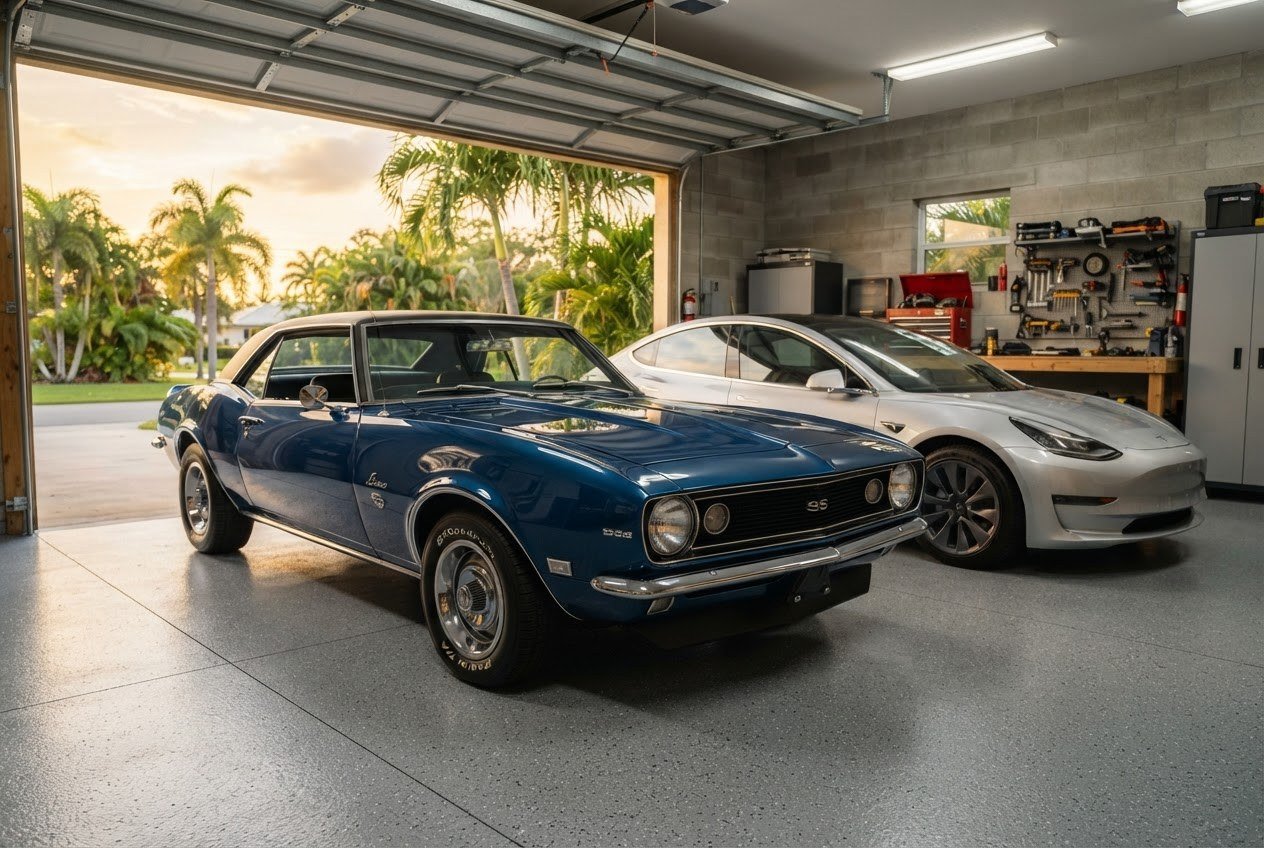
Take a 1968 Camaro, restored over four years, with $58,000 of receipts and a realistic market value of $62,000. It is garaged in Broward County and driven to shows about 1,500 miles a year. Now total it in a covered loss.
| Policy type on the car | How the claim is settled | Check you receive |
|---|---|---|
| Standard auto policy, ACV ($1,000 deductible) | The carrier’s valuation tool treats it as a 58-year-old used car and comes back around $31,000. You dispute it, hire your own appraiser, and settle in the middle | ~$30,000 to $40,000, months later |
| Stated value $62,000 | The adjuster establishes ACV first, then applies “lesser of”. If their ACV is $38,000, the stated figure never enters the calculation | ~$37,000 after deductible |
| Agreed value $62,000 | The amount was documented and accepted when the policy was issued. No depreciation, no appraisal fight, and many collector carriers waive the deductible on a total loss | $62,000 |
The gap is roughly $24,000 on one vehicle — and the collector policy that produces the top line is frequently cheaper than the standard policy that produces the bottom one, because collector carriers rate on limited mileage and secure storage rather than on daily commuting exposure.
The Florida rules that make this urgent
The 80 % total-loss threshold
Under Florida law a motor vehicle is a total loss when the cost of repairing it reaches 80 % or more of the cost of replacing it with one of like kind and quality (Fla. Stat. § 319.30(3)). For a specialty car this threshold arrives quickly: one damaged quarter panel on a car with no reproduction sheet metal, or a single airbag deployment on a low-production model, can push a repair estimate past the line. Once you are in total-loss territory, the valuation clause is the entire claim.
Hurricanes and comprehensive coverage
Florida’s other reality is water. Comprehensive coverage — not collision — is what responds to flood, falling trees and storm debris, and it is optional on a Florida auto policy. A garaged collector car with no comprehensive coverage is uninsured against the peril most likely to destroy it. Carriers also stop writing new business and binding coverage changes once a named storm enters the forecast cone, so the week before landfall is exactly when you cannot fix this. Our auto insurance page covers how the pieces fit together.
Antique plates are not insurance
Florida offers antique and horseless-carriage registration for older vehicles, and drivers often assume the plate implies special coverage. It does not. The registration class and the valuation clause on your policy are unrelated: you can hold an antique plate and still be insured on plain ACV terms.
How to qualify for agreed value
Agreed value is underwritten, not simply purchased. Requirements vary by carrier, but the pattern across the collector market is consistent:
- A separate daily driver for every licensed household member. The collector car cannot be the way you get to work
- Enclosed, locked storage — a private garage or a storage facility. Carports and driveways are usually declined, and in Florida the storage question is also a flood question
- Limited use: shows, club events, parades, occasional pleasure driving. Some carriers cap annual mileage (commonly 2,500–7,500), others write “limited use” without a hard number
- Vehicle age or character: typically 20–25 years and older for classic programs, with separate programs for modern exotics, restomods and modified vehicles
- Clean driving record for all listed drivers, usually no major violations in the past three years
- Documented value: recent photographs inside and out, restoration invoices, an appraisal for higher values, and comparable auction results
An agreed value is only as good as the date it was set. Collector values have moved sharply in the last five years, and a figure agreed in 2021 can be badly behind the market. Ask your agent to revisit the amount at every renewal, and to note that spending — new paint, a drivetrain rebuild — as it happens rather than after a loss.
Five expensive mistakes we see in Florida
1. Assuming “full coverage” means full value
“Full coverage” is a sales phrase, not a policy term. It usually means liability plus collision plus comprehensive — all settled at actual cash value. It says nothing about how your car will be valued.
2. Buying stated value because it was cheaper
It is cheaper because it pays less. If your only choice is between stated value and ACV, read the exact wording — some regional carriers do write true stated-amount coverage without a “lesser of” clause, and it should never be assumed either way.
3. Confusing agreed value with gap insurance
They solve opposite problems. Agreed value protects a car that is worth more than the book says. Gap coverage protects a loan that is bigger than the car is worth — the typical financed new vehicle in its first three years. Owning one does not remove the need for the other.
4. Forgetting the parts sitting in the garage
Spare engines, a set of period wheels, NOS trim and tools are not covered by the auto policy while they sit on a shelf. They fall to your homeowners, condo or renters policy, where sub-limits and exclusions apply. Collector programs can add a spare-parts limit, often a few thousand dollars, for very little premium.
5. Letting the liability limits stay at the state minimum
Florida requires only $10,000 of PIP and $10,000 of property damage liability; bodily injury liability is not mandatory for ordinary drivers. A collector car does not change that math — you are still driving in one of the country’s most litigated states. Fixing valuation while leaving liability at the floor solves the smaller problem.
Frequently asked questions
What is the difference between agreed value and stated value car insurance?
Does stated value insurance pay the full stated amount?
Can I get agreed value coverage on a daily driver in Florida?
When is a car a total loss in Florida?
Is classic car insurance more expensive than regular insurance?
Does agreed value cover hurricane and flood damage to my collector car?
Do I need an appraisal to set an agreed value?
Bell & Lyons: getting the valuation clause right
We read the valuation language on policies every week, and the pattern is depressingly stable: enthusiasts who believe they bought a guaranteed number, and who actually bought a cap. It takes one phone call to find out which one you own. If it is the wrong one, moving a qualifying vehicle onto a collector policy with a properly documented agreed value is usually a same-week change — and often a cheaper one.
We are an independent agency in South Florida, we compare several carriers rather than represent one, and we cover the whole state — Miami, Fort Lauderdale, Boca Raton, West Palm Beach, Orlando, Tampa, Naples, Jacksonville, Sarasota and St. Petersburg.
Is your car insured for what it is worth?
Send us your current declarations page. We will tell you which valuation clause you have, and what an agreed value on the same vehicle would cost.
Review my policyWe speak English, French and Spanish.